If you need a Canadian document recognized by a foreign government, court, or institution, you may be asked to obtain an apostille certificate. Canada joined the Hague Apostille Convention on January 11, 2024, which means a single apostille from a Canadian authority is now accepted in over 125 countries. This article explains what an apostille is, which documents require notarization before one can be obtained, and what to do if the country you are dealing with is not part of the Convention.
What Is an Apostille?
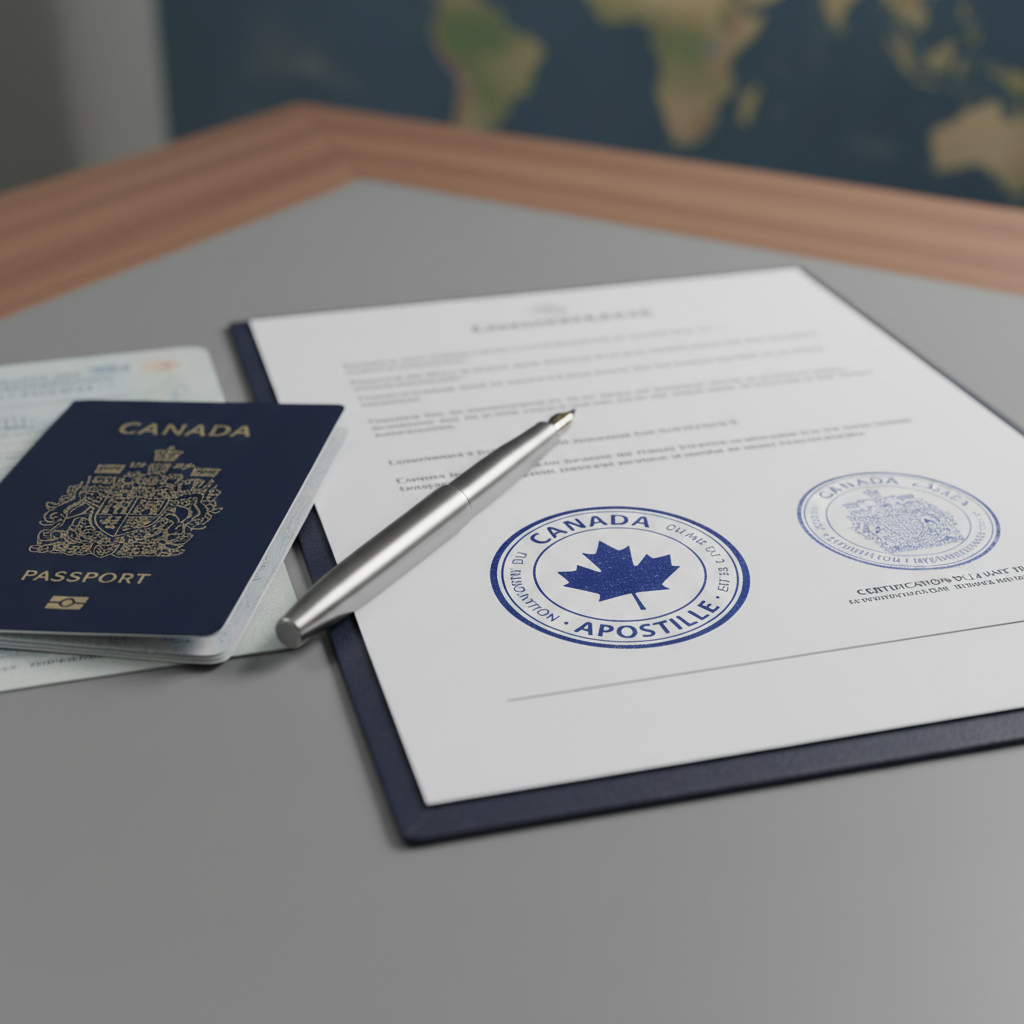
An apostille is a standardized authentication certificate issued under the Hague Convention Abolishing the Requirement of Legalisation for Foreign Public Documents. It authenticates the origin of a document — confirming that the signature, seal, or stamp on it is genuine — so that foreign authorities in member countries will accept it without further verification.
The apostille does not validate the content of the document. It simply confirms that the document was issued or certified by a recognized Canadian authority.
When Do You Need an Apostille?
You need an apostille when a foreign authority requires a Canadian document to be authenticated before they will accept it. Common situations include employment or professional licensing abroad, marriage in a foreign country, foreign immigration or residency applications, university credential recognition, property transactions in another country, and court or legal proceedings in a foreign jurisdiction. The requesting authority will normally specify that an apostille is required — confirm with them directly before taking any steps.
Who Handles Apostilles in Nova Scotia?
Because Nova Scotia does not have its own designated competent authority, documents issued or notarized in Nova Scotia are sent to Global Affairs Canada in Ottawa for authentication and apostille. Global Affairs Canada does not charge a fee for this service, but you must submit the original document by mail or in person. Check the Global Affairs Canada website for current processing times before submitting — processing typically takes several weeks plus mailing time.
Which Documents Do Not Require Notarization?
A number of commonly requested documents can be submitted directly to Global Affairs Canada for authentication without being notarized first, because they already bear an original government signature, seal, or stamp that Global Affairs Canada can verify. These include:
- Birth, death, marriage, and domestic partnership certificates — provided they are issued by a provincial or territorial vital statistics office (not notarized copies, not hospital-issued documents)
- Divorce certificates — signed by a clerk of the court
- Court orders and judgments — bearing the original seal, signature, and printed name of a judge, registrar, or clerk
- RCMP criminal record checks — issued by RCMP headquarters in Ottawa, signed by the Director General, and bearing the official RCMP dry seal
- College and university diplomas and transcripts — original diplomas from recognized Canadian post-secondary institutions, and transcripts signed by the registrar
- Canadian passport
- Canadian citizenship certificate
- Corporations Canada documents — federal incorporation certificates and similar documents bearing an original signature or seal
- Export permits issued by the Government of Canada
- Canadian Food Inspection Agency certificates
For these documents, you submit the original directly to Global Affairs Canada. No prior visit to a Notary is needed.
Which Documents Must Be Notarized First?
As a general rule, any document that does not bear a recognized original government signature or seal must be notarized before Global Affairs Canada can authenticate it. This includes:
- Affidavits and statutory declarations
- Powers of attorney
- Bank statements and financial records
- Business and corporate records (commercial invoices, letters of employment, reference letters, articles of incorporation)
- Adoption papers
- Apprenticeship and trade certificates
- Elementary and high school diplomas and transcripts
- Burial and cremation documents
- Coroner's certificates
- Notarized copies of any document (for example, a notarized copy of a passport or degree)
- Any document not specifically listed — if in doubt, notarization is required
For these documents, the process is: notarization by a Nova Scotia Notary first, then submission to Global Affairs Canada for the apostille. Worry Free Will & Notary can handle the notarization step. The apostille application is a separate step that you complete directly with Global Affairs Canada.
Countries That Accept Canadian Apostilles
As of early 2026, there are 129 countries that are parties to the Hague Apostille Convention. A Canadian apostille is accepted in all of them. Major countries in this group include:
Americas: United States, Mexico, Brazil, Argentina, Colombia, Chile, Peru, Venezuela, and most of Central America and the Caribbean.
Europe: All European Union member states (including France, Germany, Italy, Spain, the Netherlands, and Poland), the United Kingdom, Switzerland, Norway, and Ukraine.
Asia-Pacific: Australia, New Zealand, Japan, South Korea, China, India, Indonesia, Philippines, Singapore, and Kazakhstan.
Middle East and Africa: Saudi Arabia, Israel, Bahrain, Oman, Morocco, South Africa, and Namibia.
The full current list is maintained at hcch.net.
Countries That Are Not Party to the Convention
A number of countries — including several in the Middle East, Southeast Asia, and sub-Saharan Africa — are not members of the Hague Apostille Convention. Notable examples include Egypt, the United Arab Emirates, Vietnam (acceding but not yet in force), and many African nations. For these countries, an apostille is not sufficient, and you must go through a different process called legalization.
Legalization involves a chain of authentications: notarization by a Canadian Notary, authentication by Global Affairs Canada, and then legalization by the embassy or consulate of the destination country in Canada. Each step validates the one before it. The process is more time-consuming and the requirements vary by country — contact the destination country's embassy or consulate in Canada to confirm exactly what they require.
Practical Notes
Processing time. Global Affairs Canada currently processes requests received approximately 20 business days prior — add mailing time on top of that. There is no expedited service. Plan well in advance of any deadline.
Document currency. The apostille itself does not expire, but the underlying document may have a currency requirement set by the requesting foreign authority. A criminal record check, for example, is typically only accepted if it is recent.
Translation. If the document is not in English or French, a certified translation is also required. This is arranged separately from the apostille.
No fee. Global Affairs Canada does not charge a fee for authentication or apostille services.
Need a Document Notarized?
Notarization from $39. Appointments available Tuesday & Friday in Halifax, Monday & Thursday in Dartmouth.