When someone dies in Nova Scotia, their estate often must go through a court process called probate before their assets can be distributed. For many families, this is unfamiliar territory — an administrative process that arrives at an already difficult time. This guide explains how probate works in Nova Scotia, when it is required, what it costs, and what your Executor will need to do.
What Is Probate?
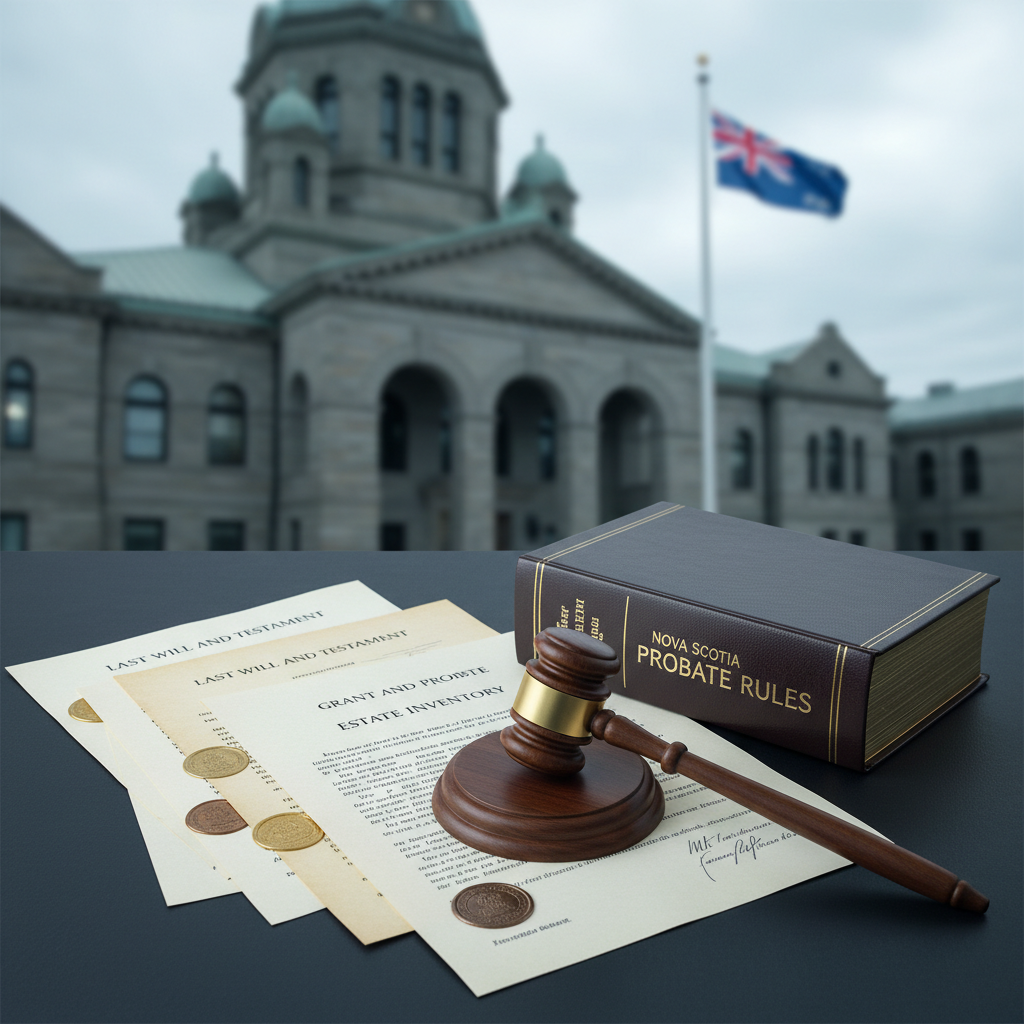
Probate is the legal process by which the Nova Scotia Supreme Court (Probate Division) confirms that a Will is valid and grants the Executor the legal authority to administer the estate. The court issues a document called a Grant of Probate, which is the official instrument used to deal with banks, the Land Registry, investment institutions, and other third parties.
Without a Grant of Probate, most institutions will not release assets or transfer property — even if the Executor is clearly named in the Will. The Grant is, in effect, the Executor's licence to act.
When Is Probate Required?
Not every estate requires probate. As a general rule, probate is needed when:
- The estate includes real property (land or a house) registered in the deceased's name alone
- A bank or financial institution requires a Grant before releasing funds or transferring investment accounts
- There is a dispute about the validity of the Will
- The estate includes significant assets held solely in the deceased's name with no named beneficiary
Probate is not required for assets that pass outside the estate entirely. These include:
- Jointly held property (which passes automatically to the surviving joint owner)
- Life insurance, RRSPs, RRIFs, and TFSAs with a named beneficiary
- Pension death benefits paid directly to a named beneficiary
Careful estate planning can reduce — or in some cases eliminate — the assets that need to flow through the probate process, which reduces both cost and delay.
The Probate Application
To apply for probate in Nova Scotia, the Executor files documents with the Supreme Court (Probate Division). The core requirements are:
- The original Will — not a photocopy. The original must be filed with the court.
- An Affidavit of Executor — a sworn statement by the Executor confirming their appointment and willingness to act.
- An inventory of estate assets — a detailed list of all assets subject to probate and their estimated values at the date of death.
- The probate fee — calculated based on the gross value of the probatable estate.
Once the court is satisfied that the Will is valid and the documentation is complete, it issues the Grant of Probate. The Executor can then use certified copies of the Grant to access and transfer assets.
The Affidavit of Execution
A Will prepared through Worry Free Will includes a notarized Affidavit of Execution — a sworn statement signed by one of the witnesses confirming that the Will was properly signed in their presence and in the presence of the other witness. This document is filed with the probate application.
Its value is practical: without an Affidavit of Execution, the court may require the Executor to locate one of the original witnesses to swear an affidavit after the fact. If the witnesses have moved, died, or cannot be found, this creates delay and expense. A notarized Affidavit of Execution prepared at the time of signing eliminates this problem entirely.
Probate Fees in Nova Scotia
Nova Scotia charges probate fees based on the gross value of the probatable estate under the Probate Act. The fee schedule works as follows: $1,002.65 on the first $100,000, plus $16.95 for every $1,000 (or portion thereof) above $100,000. For a $500,000 probatable estate, the fee is approximately $7,782 ($1,002.65 + 400 × $16.95). For a $1,000,000 estate, it is approximately $16,258 ($1,002.65 + 900 × $16.95).
This is a meaningful cost, and it applies to the gross value of the estate — not the net value after debts. Assets that pass outside the estate (jointly held property, assets with named beneficiaries) are not included in this calculation, which is one reason careful beneficiary designation and joint ownership planning can reduce probate exposure.
The Executor's Role During Probate
The Executor's job does not end with obtaining the Grant of Probate — it begins there. Once the Grant is in hand, the Executor must:
- Notify all beneficiaries of the estate
- Open an estate bank account to receive and disburse funds
- File the deceased's final income tax return and any outstanding returns
- Pay all debts and liabilities of the estate
- Obtain a clearance certificate from the Canada Revenue Agency before distributing the estate
- Transfer or sell real property as directed by the Will
- Distribute the remaining estate to beneficiaries
- Prepare a final accounting if required
This process routinely takes six months to a year for a straightforward estate. Contested estates, complex tax situations, or properties that are difficult to sell can extend the timeline considerably.
What Happens If There Is No Will?
If the deceased died without a Will — called dying intestate — the estate still goes through a court process, but there is no Executor. Instead, the court appoints an Administrator, typically the deceased's closest next of kin. The Administrator performs the same function as an Executor but must post a bond, and the estate is distributed according to the Intestate Succession Act rather than the deceased's wishes.
Intestacy means that common-law partners receive nothing regardless of the length of the relationship, that specific gifts to friends or charities cannot be honoured, and that minor children's shares are paid into court until they reach the age of majority. A valid Will avoids all of this.
Timeline for Probate in Nova Scotia
A straightforward probate application in Nova Scotia typically takes several weeks to a few months from the date of filing. The court does not currently offer expedited processing. Contested applications — where someone is challenging the validity of the Will — can take significantly longer and will require legal proceedings before the probate court.
Reducing the Burden on Your Estate
While probate cannot always be avoided, it can be managed. The most effective strategies include:
- Ensuring all registered accounts (RRSPs, TFSAs, RRIFs) have named beneficiaries rather than defaulting to the estate
- Reviewing life insurance beneficiary designations regularly
- Understanding whether joint ownership of property is appropriate for your situation
- Having a properly executed Will with a notarized Affidavit of Execution, which simplifies and speeds up the court process
A properly prepared Will does not eliminate probate, but it makes the process as smooth as possible for the Executor and reduces the risk of delay, additional legal costs, or court complications.
Get Your Estate Documents in Order
One appointment. One hour. $395 for a Will, Power of Attorney, and Personal Directive — everything signed, witnessed, and notarized.